




Speech Therapy
Regain Your Voice. Regain Your Confidence.
Dedicated to Your Voice and Your Health
By combining advanced clinical expertise with personalized care, speech therapy empowers individuals to overcome communication, swallowing, and cognitive challenges so they can return to their daily lives with confidence and independence.
Visit us Today
RUPERT
1308 8th Street, Suite 1
Rupert, Idaho 83350
Call 208-436-4322
Or email [email protected]
What Is a Speech-Language Pathologist?
Speech-Language Pathologists, also called SLPs, are experts in communication and swallowing. SLPs work with people of all ages, from babies to adults, treating a wide range of conditions that affect how people speak, understand, eat, and think.
Specific conditions we treat:
- Aphasia
- Apraxia of Speech
- Cognitive Communication Disorders
- Dysphagia
- Dysarthria
- Speech Sound Disorders
- Language Disorders
- Voice and Fluency Disorders

How to schedule an appointment
If you are interested in speech therapy services offered at MMH, talk to your provider about getting a referral. Once the SLP receives the referral, you will be contacted to schedule an appointment. While you are waiting to schedule, feel free to contact your insurance company to determine if you qualify for coverage.
What do these appointments look like?
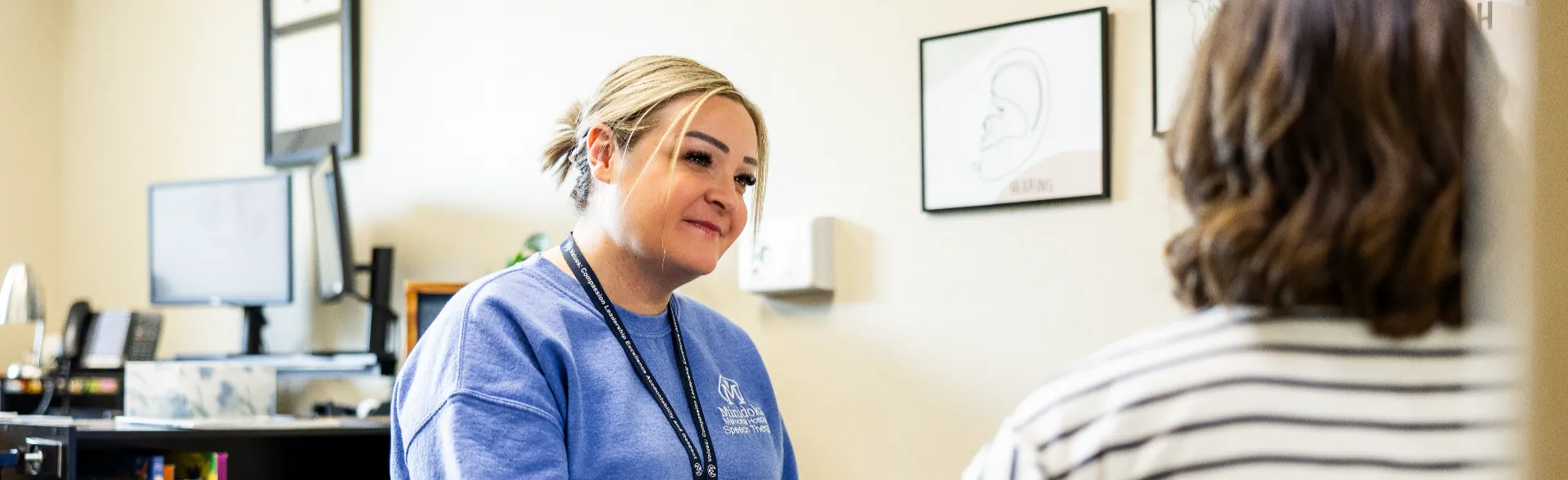
We use a Whole Person Health approach. Patients and caregivers work with Rachel to set meaningful goals for each session — goals that reflect what matters most in that person's daily life. Sessions are structured to meet the needs of each individual, not a one-size-fits-all protocol.
A Speech Therapist Can Help With
What a speech-language pathologist treats:
- Speech Sounds: How we say sounds and put sounds together into words
- Language: How well we understand what we hear or read and how we use words to tell others what we are thinking.
- Social Communication: How well we follow rules, like taking turns, how to talk to different people, or how close to stand to someone when talking.
- Voice: How our voices sound. We may sound hoarse, lose our voices easily, talk too loudly or through our noses, or be unable to make sounds.
- Fluency: Also called stuttering, is how well speech flows.
- Cognitive Communication: How well our minds work. Problems may involve memory, attention, problem solving, organization, and other thinking skills.
- Feeding & Swallowing: How well we suck, chew, and swallow food and liquid.
- Augmentative and Alternative Communication: All of the ways that someone communicates besides talking.

Meet Our Specialist
We are committed to helping every patient reach their full potential through specialized therapy that restores vital communication functions and ensures safe, healthy swallowing.

Rachel Durrant | MS, CCC-SLP
Speech Therapy
1308 8th Street, Suite 1
Rupert, ID 83350
(208) 436-4322
Minidoka Memorial Hospital
1224 8th Street
Rupert, ID 83350
Minidoka Medical Center RHC
1308 8th St #1
Rupert, ID 83350
Minidoka Memorial Orthopedic Center and Imaging
260 E 5th St N
Burley, ID 83318